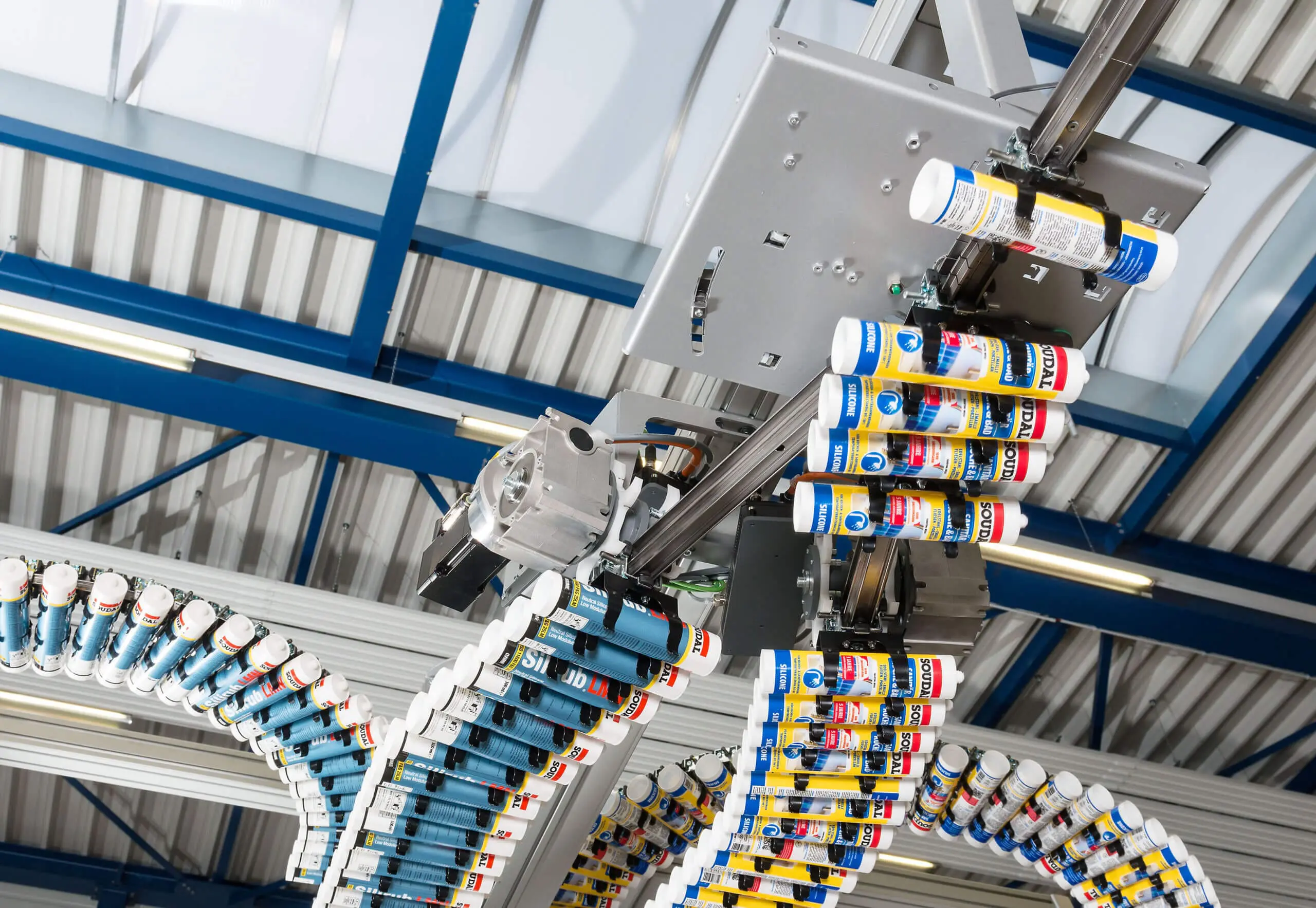
Designing Scalable Fulfilment with ferag.skyfall
Omnichannel warehouse automation has become a strategic priority for retailers and manufacturers managing large assortments, multiple sales channels and rising order volumes.
Across electronics, household goods and consumer products, fulfilment operations are under pressure to deliver:
- Later order cut-offs
- Faster dispatch and delivery
- High pick accuracy
- Efficient returns processing
- Lower cost per order
At the same time, labour availability remains constrained and facility expansion is increasingly expensive.
In this environment, performance is no longer defined by isolated automation initiatives. It is determined by how effectively fulfilment architecture is designed around scalable, integrated systems, with ferag.skyfall at its core.
The Operational Challenge: Complexity Drives Cost
Expanding product ranges increase SKU counts and inventory levels. Omnichannel strategies fragment order structures into smaller, more frequent shipments. Promotional peaks and seasonal volatility add further pressure.
Without a structured automation strategy, organisations typically experience:
- Rising fulfilment cost per order
- Labour-intensive picking and consolidation
- Underutilised vertical space
- Bottlenecks between storage, picking and dispatch
- Limited scalability without major reinvestment
Incremental automation often results in fragmented subsystems rather than sustainable performance improvement.
Long-term order fulfilment optimisation requires a structural approach, not disconnected technologies.
ferag.skyfall: Scalable Automation in the Third Dimension
At the centre of scalable omnichannel fulfilment stands ferag.skyfall, an automated overhead pouch system that combines conveying, buffering, sorting, sequencing and consolidation within a single integrated platform.
By systematically using overhead space, ferag.skyfall frees valuable floor area for value-adding processes while transforming unused cubic volume into high-performance logistics capacity.
With throughput capacities of up to 12,000 load carriers per hour and load capacities of up to 20 kg per carrier, the system delivers the stability required for high-volume omnichannel environments.
Operationally, ferag.skyfall enables:
- Dynamic buffering to decouple upstream and downstream processes
- Continuous material flow without floor congestion
- Higher pick density and reduced walking distances
- Stable throughput during daily and seasonal peaks
- Full traceability across the fulfilment process
Rather than treating conveying, sorting and buffering as separate disciplines, ferag.skyfall integrates them into one cohesive material flow architecture.
The measurable impact includes:
- Shorter order cycle times
- More predictable dispatch performance
- Improved labour productivity
- Significantly better space utilisation
Integrated Control for End-to-End Performance
Hardware performance alone does not guarantee efficiency. To unlock its full value, automation must operate within a coordinated control framework.
Ferag’s software architecture supports ferag.skyfall through unified warehouse control and execution capabilities, synchronising manual and automated workflows while providing real-time system visibility.
For operational leadership, this enables:
- Real-time inventory transparency
- Centralised monitoring of throughput and resource utilisation
- Data-driven performance optimisation
- Integration with existing ERP and higher-level systems
The result is a single operational view across the fulfilment process, essential for reducing cost variability and increasing service reliability.
Reducing the Cost of Order Fulfilment
The strategic objective of omnichannel automation is measurable economic improvement.
With ferag.skyfall at the core of the fulfilment architecture:
- Overhead utilisation increases capacity without physical expansion
- Dynamic buffering absorbs peaks without proportional labour growth
- Integrated material flow reduces manual handling and error rates
- Structural transparency enables continuous optimisation
These improvements directly impact:
- Labour cost per order
- Space utilisation ratios
- Asset productivity
- Throughput stability
- Overall cost of order fulfilment
The focus shifts from incremental efficiency gains to structural performance optimisation.
Automation That Grows with the Business
Forecasting future demand with precision is increasingly difficult. Product portfolios evolve. Channels shift. Growth patterns change.
Scalable automation must therefore combine robustness with adaptability.
ferag.skyfall is engineered as a modular system, enabling capacity extensions and functional expansion without disrupting ongoing operations. This protects capital investment while allowing organisations to scale in line with real demand.
This approach enables organisations to:
- Align capital expenditure with growth
- Expand incrementally without structural redesign
- Maintain operational continuity
- Secure long-term resilience
From Complexity to Competitive Advantage
Large assortments and omnichannel distribution are structural realities of modern commerce.
When designed around ferag.skyfall as an integrated overhead fulfilment architecture, warehouse automation transforms operational complexity into measurable performance:
- Lower fulfilment costs
- Higher space efficiency
- Stable throughput under volatility
- Improved operational transparency
Efficiency is not achieved through isolated subsystems.
It is engineered through architectural clarity and integrated performance design. With ferag.skyfall at the core, fulfilment operations gain the scalability and structural stability required to grow with confidence, while protecting profitability.
