
How overhead pouch systems improve fulfilment flow, maximise warehouse space and support buffering, sequencing and order consolidation across a wider range of products
Mention pouch-based automation and many logistics professionals immediately think of hanging garments.
That association is understandable. For many years, pouch systems were closely linked with apparel distribution, where they helped retailers handle garments efficiently through fulfilment, returns and store replenishment processes.
But that view no longer reflects how many distribution centres operate today.
Modern fulfilment environments are more complex, more space-constrained and more dependent on flexible product flow. Retailers, e-commerce businesses and logistics providers are no longer only asking how quickly products can be stored or picked. They are also asking how efficiently goods can move, be buffered, sequenced, consolidated and released into the next stage of the operation.
That is where pouch-based automation has moved beyond its traditional perception.
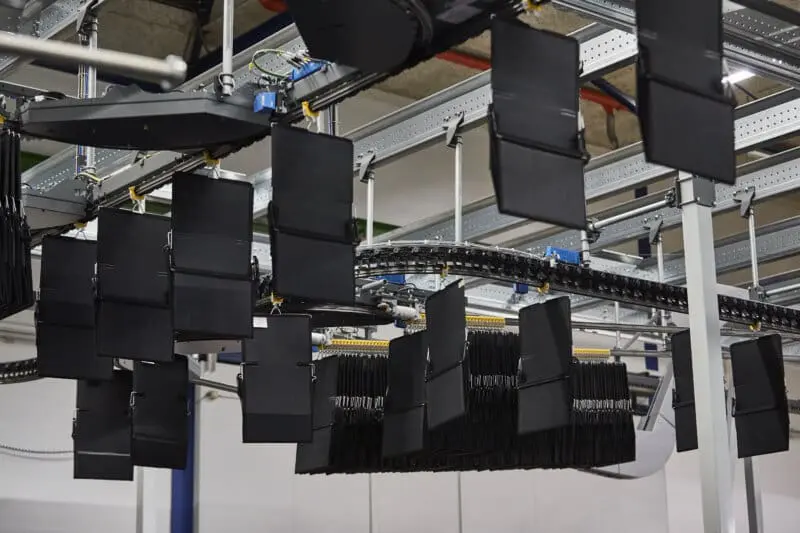
Systems such as ferag.skyfall are not simply designed to transport products from one point to another. They can combine conveying, buffering, sorting, sequencing and consolidation within a single overhead system, helping businesses manage flow more intelligently across the distribution centre.
The real challenge is often flow, not storage
Many fulfilment operations focus heavily on storage capacity, picking productivity and throughput.
These are important measures, but they do not always explain where operational inefficiencies actually occur.
In many distribution centres, the bigger issue is flow.
Products arrive before they are needed. Orders need to be consolidated from different zones. Returns must be reintroduced into stock quickly, without creating additional storage, handling or picking processes. Store replenishment, e-commerce fulfilment and click-and-collect orders may all compete for the same resources. As order profiles become more fragmented, maintaining a smooth and controlled product flow becomes harder.
This is where modern pouch sorter systems can add value.
Rather than acting only as a transport mechanism, pouch-based automation can create a controlled environment for buffering, sorting, sequencing and order consolidation. Products can be held temporarily, released in the right order and directed to the right process at the right time.
The benefit is not only movement. It is control.
Making better use of warehouse space
Warehouse space remains one of the most valuable resources in the supply chain.
Many automation projects focus on what happens at floor level: storage, picking, packing, dispatch and returns. Yet in many facilities, there is still underused capacity above these areas.
Overhead pouch-based systems make use of this vertical space for transport and buffering. This can help free up floor-level areas for value-adding processes such as picking, packing, replenishment and dispatch.
For businesses dealing with growing order volumes, limited expansion options or high property costs, using the available cube of the building more effectively can be just as important as increasing throughput.
This is one of the reasons pouch-based automation is becoming relevant beyond traditional fashion logistics. Its value is not limited to what it carries. It is also in where and how it moves goods through the operation.
Beyond hanging garments
The perception that pouch systems are mainly for hanging garments is increasingly outdated.
Modern pouch-based automation can support a wider range of goods, depending on the application, product profile and carrier type. In some operations, this may include hanging garments. In others, it may include flat goods, small items, returns, parcels or products handled in soft or hard pouch carriers.
The important point is that the pouch is only one part of the system.
The wider value lies in the ability to move individual items through a controlled automated process, hold them in a dynamic buffer, sequence them for packing or dispatch, and consolidate orders more efficiently.
For omnichannel operations in particular, this can make a significant difference. A single distribution centre may need to support e-commerce orders, store replenishment, returns processing and click-and-collect flows at the same time. Each flow may have different priorities, cut-off times and handling requirements.
A flexible pouch sorter system can help bring more structure to that complexity.
Supporting modern fulfilment requirements
The demands placed on distribution centres have changed significantly over the past decade.
Many facilities are now expected to handle more channels, more order types and more frequent operational change. The result is a growing need for automation technologies that can support agility as well as performance.
Solutions such as ferag.skyfall are increasingly being considered not only because they move products efficiently, but because they help businesses manage complex fulfilment flows. By combining transport, buffering, sorting, sequencing and consolidation, the system can support multiple processes within one integrated automation environment.
In many cases, the value lies less in the individual item being transported and more in how the system orchestrates movement across the wider operation.
Looking beyond traditional assumptions
The most successful automation strategies are rarely driven by technology alone. They are driven by operational outcomes.
For logistics leaders evaluating warehouse automation, the more relevant question may no longer be whether pouch-based systems are suitable for garments. It may be whether they can help solve broader challenges around space utilisation, product flow, order consolidation, returns handling and operational flexibility.
As fulfilment operations continue to become more complex, businesses that evaluate automation technologies based on current capabilities rather than historical assumptions may find opportunities others overlook.
Modern pouch-based automation is no longer defined by what it carries. It is defined by the operational challenges it helps solve.
Planning to improve fulfilment flow? Ferag can help you explore how ferag.skyfall supports sorting, buffering, sequencing and order consolidation within a single overhead system.
Related insights



FAQ’s:
No. While pouch-based systems have traditionally been associated with hanging garments and fashion logistics, modern pouch automation can support a wider range of fulfilment processes, including sorting, buffering, sequencing, returns handling and order consolidation.
The main benefit is improved product flow. Pouch-based automation can help move, buffer, sequence and consolidate individual items more efficiently, supporting better control across complex warehouse and fulfilment operations.
An overhead pouch system uses vertical space for transport and buffering, helping to free up floor-level areas for storage, picking, packing, replenishment and dispatch activities.
ferag.skyfall supports modern fulfilment by combining conveying, buffering, sorting, sequencing and order consolidation within a single overhead system. This can help businesses manage more complex e-commerce, store replenishment, returns and omnichannel fulfilment flows.
Yes. Pouch-based automation can support omnichannel fulfilment by helping different order types, channels and process flows move through the warehouse more efficiently, with greater control over sequencing, consolidation and release.
